
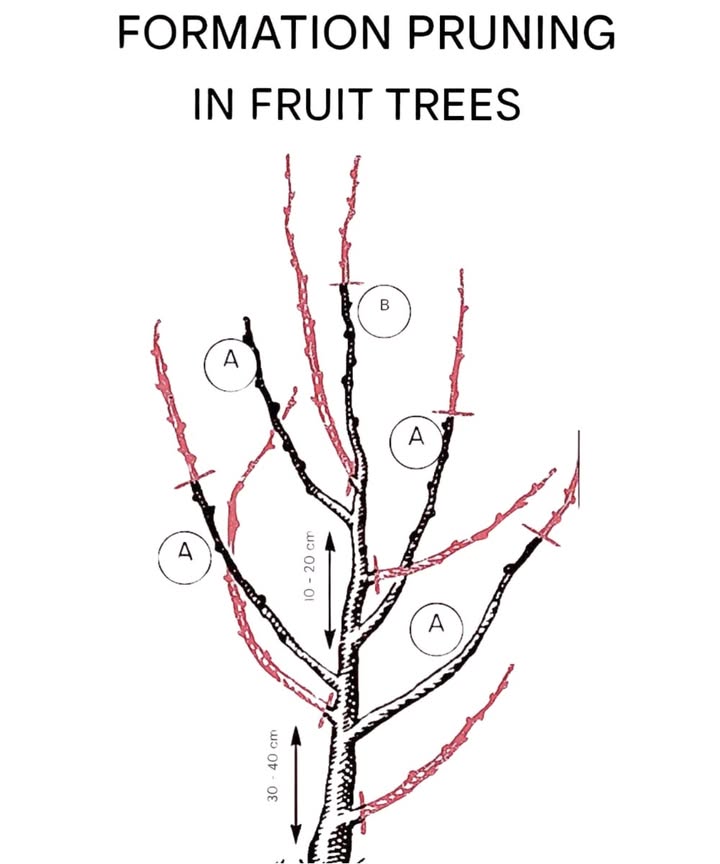
Training Pruning in Fruit Trees
1 Trunk height
Keep the trunk clear for 30 to 40 cm above the ground.
Remove all suckers and low branches competing with the base.
2 Selection of main branches A
Choose 3 to 5 well-spaced branches around the trunk.
These branches will form the framework of the canopy.
Keep 10 to 20 cm of spacing between them to ensure balance and good airflow.
3 Cutting secondary branches
Remove overly upright shoots or those growing towards the inside of the canopy.
Cut crossing or crowded branches that block sunlight penetration.
4 Support branch Б
Maintain the central leader as a guide to ensure steady and balanced growth.
5 Purpose of pruning
Create an open, well-lit canopy.
Improve air circulation, reducing pests and diseases.
Encourage more abundant and higher-quality fruiting.
Training pruning should be done during the first years of the tree to secure healthy growth and productivity throughout its life.

Hi there — I’m Ava, the creator behind Ava Garden Tips 🌿
I’ve always been passionate about plants, flowers, and the simple joy that comes from growing something beautiful. What started as a small balcony garden has turned into a love for helping others create their own green spaces — no matter how big or small.