
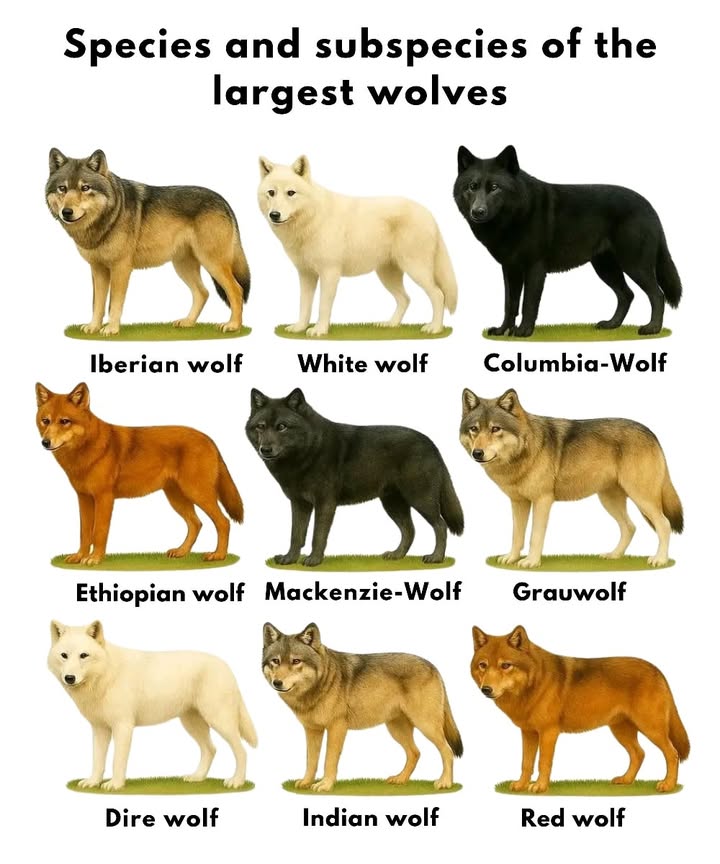
Types and Subspecies of Wolves The Largest Representatives
Wolves are among the most fascinating predators on our planet. Over thousands of years, they have adapted to diverse habitats, climates, and food sources, leading to a remarkable variety of species and subspecies. Depending on their environment, wolves differ in size, coat color, and behavior. Below are some of the most well-known and impressive wolf species around the world.
1. Iberian Wolf Canis lupus signatus
Found mainly in Spain and Portugal, the Iberian wolf is medium-sized, with a grayish-brown coat and distinctive dark stripes on its forelegs. Although protected, it remains threatened in many regions.
2. Arctic Wolf Canis lupus arctos
This subspecies inhabits the frozen regions of the Canadian Arctic and Greenland. Its white coat provides perfect camouflage in the snow. Adapted to extreme cold, it survives by hunting musk oxen and caribou.
3. Columbian Wolf Canis lupus columbianus
Native to the forests and mountain ranges of Canada and the U.S., this wolf is large, strong, and often dark-colored. It thrives in dense woodlands as well as higher elevations.
4. Ethiopian Wolf Canis simensis
One of the rarest wolf species in the world, the Ethiopian wolf lives in the highlands of Ethiopia. Unlike most wolves, it often hunts alone, primarily targeting rodents. Its reddish coat makes it instantly recognizable.
5. Mackenzie Wolf Canis lupus mackenzii
This large subspecies inhabits northern Canada. Typically black or dark gray, it is highly adaptable. Its size and strength make it one of the most impressive wolves in North America.
6. Gray Wolf Canis lupus
The most widespread and iconic wolf species, the gray wolf ranges across Europe, Asia, and North America. It varies greatly in size and coloration, but everywhere it remains a powerful symbol of wilderness and resilience.
7. Dire Wolf Canis dirus, extinct 領
Although extinct, the dire wolf continues to spark fascination. It lived during the Ice Age in North and South America, was stockier than todays gray wolf, and specialized in hunting large prey.
8. Indian Wolf Canis lupus pallipes
Smaller and more lightly built than its northern relatives, the Indian wolf inhabits dry regions of India and the Middle East. With its sandy-colored coat, it preys mostly on small animals.
9. Red Wolf Canis rufus
A rare species native to the southeastern United States, the red wolf has a slender frame and reddish-brown fur. Critically endangered, it is the focus of conservation breeding programs.
The Role of Wolves in Nature
Wolves are vital to ecosystems. By controlling wild animal populations, they help maintain balance and prevent overgrazing. Without them, entire landscapes can become disrupted and lose their natural diversity.

Hi there — I’m Ava, the creator behind Ava Garden Tips 🌿
I’ve always been passionate about plants, flowers, and the simple joy that comes from growing something beautiful. What started as a small balcony garden has turned into a love for helping others create their own green spaces — no matter how big or small.